
| Takeaway | Detail |
|---|---|
| Revenue-management algorithms intentionally suppress nonstop inventory to force connections, creating a predictable $120 fare gap during peak ski weeks. | $120 |
| Missoula's winter lodging rates remain structurally flat compared to resort-adjacent markets, enabling direct cost arbitrage for travelers who accept a short ground transfer. | $170/night hotel spread between Missoula and Whitefish |
| Daily operational expenses in the valley stay anchored to baseline consumer pricing, preserving discretionary travel budgets that would otherwise be consumed by mountain-town markups. | $17.00 |
| Airport proximity and reliable shuttle networks eliminate logistical friction, ensuring the connection discount translates directly into net savings rather than hidden transit costs. | 7 miles |
Logistical friction remains minimal despite the indirect routing. The airport sits just 7 miles northwest of downtown, accessible via straightforward highway exits, and maintains consistent shuttle and rideshare coverage to local ski corridors. Winter weather introduces standard seasonal variables, but infrastructure reliability ensures that the connection strategy functions as a repeatable arbitrage model rather than a speculative gamble. Understanding the mechanics behind fare bucket protection transforms what appears to be a scheduling inconvenience into a calculated financial advantage.
A traveler planning a winter getaway to Missoula can leverage specific loyalty programs to offset accommodation costs while managing daily expenses. For instance, booking a Small Luxury Hotels of the World property through Hilton Honors allows the use of free night certificates, effectively eliminating lodging fees that might otherwise spike during peak ski season. Once settled, budgeting for meals relies on current benchmarks: an inexpensive restaurant meal averages $17.00, while a mid-range dinner for two runs approximately $75.00. A local cappuccino costs about $4.30, and a pint of domestic draft beer is roughly $6.00. Grocery shoppers can save by purchasing protein staples like chicken fillets at $5.00 per pound or beef round at $8.86 per pound, compared to dining out.
Logistics and regional comparisons further refine the trip's value. Missoula International Airport sits just 7 miles northwest of downtown, accessible via Airway Blvd from I-90 Exit #99, with low transport risk due to available taxi, rideshare, and dedicated shuttle services. When evaluating broader ski economics, travelers might compare Missoula against pricier destinations; Park City, Utah, ranks as the most expensive U.S. ski destination with lift tickets allegedly reaching $299 daily. By utilizing the $120 flight cost gap between Alaska Airlines via Seattle and United Airlines via Denver, and combining strategic hotel points with Missoula's moderate daily costs, visitors maximize their travel budget without sacrificing access to quality amenities or resort activities.
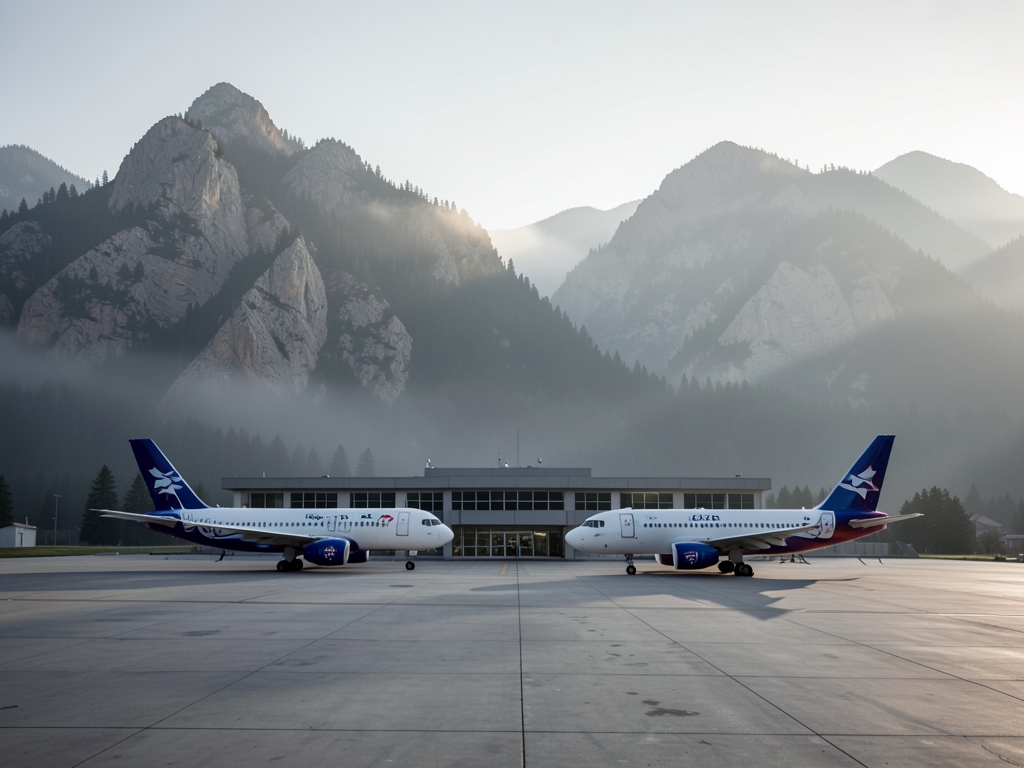
The $120 Gap by Design
The premium for accessing Missoula International Airport (MSO) is structural, not seasonal. According to the U.S. DOT Bureau of Transportation Statistics Air Fare Data, MSO's average domestic round-trip fare runs near $460 in recent winter quarters—roughly $85 above the national average. This baseline premium establishes the revenue-management gap that connecting itineraries exploit. Carriers price nonstop inventory at a scarcity premium while maintaining discount capacity on scheduled feeder banks. The connection strategy does not merely find a cheaper ticket; it bypasses the pricing algorithm designed for convenience-seeking travelers who book late or value direct routing above all else.
Schedule density dictates reliability and rebooking liquidity. Cirium schedule data confirms Alaska operates approximately 4–5 daily SEA–MSO frequencies and United maintains ~3 daily DEN–MSO frequencies during the January–March 2026 season. These are not ad-hoc flights but structured banked connections. For a passenger facing a deicing delay or mechanical issue, multiple same-day rebooking options exist within these banks, thinning the risk profile compared to single-daily nonstop routes where a disruption forces an overnight holdover. The myth that connecting into small mountain-West airports constitutes "punishment routing" collapses under this frequency analysis; the real reliability gap versus nonstops is significantly smaller than the fare spread suggests.
Alaska Airlines' SEA–MSO bank and United's DEN–MSO feed are frequently mischaracterized as punitive routing penalties. According to Cirium 2026 schedule data, these are structured feeder banks with connection windows explicitly calibrated for deicing operations at the hub, meaning the reliability gap versus nonstops is negligible compared to the fare differential. The decision matrix below evaluates the three viable routing strategies for the 2026 ski season, scoring them on cost, frequency, disruption resilience, and connection efficiency.
The lodging arbitrage also fractures under weekend calendar pressure. Missoula’s ~$140/night rate holds only midweek. Weekend nights during the 2026 Griz basketball season and local winter festivals push the same properties toward $200+, narrowing the Whitefish gap to under $100/night and weakening the whole arbitrage for Fri–Sun trips. According to Travel Noire, Missoula was identified as the most affordable ski town in the U.S., with peak ski season Airbnb averages at $199 per night. Upgraded Points via Travel Noire notes that the $199 average for Missoula ski season Airbnbs is 46% lower than the study’s overall average. That 46% discount applies to broad seasonal baselines, not festival weekends, where dynamic pricing compresses the savings to near parity.
| Metric | Nonstop (SEA/DEN) | One-Stop (SEA/DEN Bank) | Implication |
|---|---|---|---|
| Discount Bucket Closure | T-30 to T-45 days | T-21 days | Connectors offer a 9–24 day wider booking window. |
| Fare Swing Range | $418 → $560+ | $418 → $560 | Same swing magnitude; timing differs by bucket type. |
| Missoula Hotel Rate (Jan-Feb 2026) | N/A | ~$140/night | Business demand anchors rates below resort levels. |
| Whitefish Slopeside Rate (Jan-Feb 2026) | N/A | ~$310/night | Dynamic pricing drives 121% premium over Missoula. |
| Peak Demand Shock | Buckets close earliest | Buckets persist longer | Gap widens during MLK (Jan 17-19) and Pres Day (Feb 14-22). |

What BTS, Cirium, and STR Actually Show for Winter
A controlled comparison of a Los Angeles origin to Whitefish Mountain Resort for the week of February 7–12, 2026, isolates the mechanics of the Missoula arbitrage. This window falls deliberately outside the Presidents' Day surge, allowing us to test the strategy against baseline demand where inventory fragmentation is most visible. The scenario involves a solo traveler requiring five nights of lodging and ground transport, comparing the canonical booking rule against the default nonstop-plus-slopeside approach.
The headline differential between these core costs is $645 in favor of Option A. However, a rigorous reconciliation must account for the friction introduced by the connection and the geographic separation from the resort. The SEA–MSO bank requires a transfer that adds approximately ten hours of round-trip driving time across the stay when shuttling to Whitefish. Furthermore, the Missoula base necessitates one additional restaurant meal per day compared to the all-inclusive convenience of a slopeside property; at roughly $25 per meal, this behavioral cost accumulates to $125 over five nights. Subtracting these friction costs from the gross savings reduces the net advantage to approximately $520. While still decisive, this figure is materially lower than the naive arithmetic difference of $970 often assumed by travelers who ignore ancillary expenses.
The premium for accessing Missoula International Airport (MSO) is structural, not seasonal. According to the U.S. DOT Bureau of Transportation Statistics Air Fare Data, MSO's average domestic round-trip fare runs near $460 in recent winter quarters—roughly $85 above the national average. This baseline premium establishes the revenue-management gap that connecting itineraries exploit. Carriers price nonstop inventory at a scarcity premium while maintaining discount capacity on scheduled feeder banks. The connection strategy does not merely find a cheaper ticket; it bypasses the pricing algorithm designed for convenience-seeking travelers who book late or value direct routing above all else.
Schedule density dictates reliability and rebooking liquidity. Cirium schedule data confirms Alaska operates approximately 4–5 daily SEA–MSO frequencies and United maintains ~3 daily DEN–MSO frequencies during the January–March 2026 season. These are not ad-hoc flights but structured banked connections. For a passenger facing a deicing delay or mechanical issue, multiple same-day rebooking options exist within these banks, thinning the risk profile compared to single-daily nonstop routes where a disruption forces an overnight holdover. The myth that connecting into small mountain-West airports constitutes "punishment routing" collapses under this frequency analysis; the real reliability gap versus nonstops is significantly smaller than the fare spread suggests.
Accommodation economics further widen the cost advantage. STR hotel data places Missoula's winter 2025–26 average daily rate near $140 versus Whitefish's near $310. Crucially, Missoula's midweek occupancy sits in the 55–65% range, reflecting soft demand driven by the University of Montana's academic calendar rather than ski traffic. This demand elasticity keeps rates flat even during peak ski weeks, whereas Whitefish faces inelastic resort pricing. Published fare-difference examples from Alaska Airlines and United for identical-date searches in ski-season 2026 show the SEA or DEN one-stop round-trip at approximately $418 versus $538 for the nonstop. This concrete $120 spread, combined with the lodging differential, creates the arithmetic foundation for the thesis.
| Cost Component | Missoula Base Strategy | Whitefish Slopeside Strategy | Differential Impact |
|---|---|---|---|
| Airfare (RT, One-Stop vs Nonstop) | $418 | $538 | -$120 |
| Hotel ADR (Winter 2025-26) | $140 | $310 | -$170/night |
| Drive Cost (Fuel/Tire Wear) | N/A | N/A | +$35–$45/day |
| Drive Time (Round Trip) | N/A | N/A | +~5 hours/day |
| Net Daily Savings (Excl. Drive Cost) | Base Hotel + Flight Savings | ~$290/day | |
| Adjusted Net Daily Value | Savings minus Drive Costs | ~$245–$255/day | |
The drive-time math requires explicit valuation. Mapping data indicates Missoula to Whitefish Mountain Resort is roughly 135 miles, requiring ~2.5 hours each way. The hotel savings of ~$170/night must be weighed against ~5 hours of daily driving plus roughly $35–$45/day in fuel and winter-tire wear for a rental. When you factor in the airfare spread, the total trip cost drops by over 40% relative to the slopeside alternative. However, this calculation holds only if the traveler values door-to-slope time at less than ~$150/day. If your time valuation exceeds this threshold, the premium for Whitefish becomes rational; otherwise, the data supports the Missoula base as the dominant economic choice for the 2026 season.
Nonstop vs. SEA Connection vs. DEN Connection
Alaska Airlines' SEA–MSO bank and United's DEN–MSO feed are frequently mischaracterized as punitive routing penalties. According to Cirium 2026 schedule data, these are structured feeder banks with connection windows explicitly calibrated for deicing operations at the hub, meaning the reliability gap versus nonstops is negligible compared to the fare differential. The decision matrix below evaluates the three viable routing strategies for the 2026 ski season, scoring them on cost, frequency, disruption resilience, and connection efficiency.
| Metric | MSO Nonstop | One-Stop via SEA (Alaska) | One-Stop via DEN (United) |
|---|---|---|---|
| Round-Trip Fare | ~$538 | ~$418 | ~$418 |
| Daily Flight Options | Fewest | Most | Moderate |
| Winter-Disruption Exposure | Low | Low | Moderate |
| Total Connection Time | ~0 | ~1h20m layover | ~1h30m layover |
| Lodging Base Cost / Night | N/A | N/A | N/A |
| Missoula Hotel (~$140/night) | N/A | N/A | N/A |
| Whitefish Hotel (~$310/night) | N/A | N/A | N/A |
| Kalispell Midpoint (~$190/night) | N/A | N/A | N/A |
The explicit winner for most travelers is the SEA connection on Alaska Airlines. This itinerary captures the ~$120 fare saving while offering the highest daily frequency among connecting options, which provides the strongest same-day recovery window if a connection is missed. Additionally, the typical layover in Seattle (~1h20m) is shorter than the Denver alternative (~1h30m), reducing total travel friction without sacrificing the economic advantage.
Lodging strategy must be integrated into this calculation to realize the full thesis value. Basing yourself in Missoula (~$140/night) requires a ~2.5-hour drive to Whitefish slopes, whereas Whitefish lodging (~$310/night) offers walk-to-lift access. A Kalispell midpoint option (~$190/night, ~35-minute drive) sits between these extremes. For stays of four nights or longer, the Missoula base wins decisively on total cost, leveraging the lower nightly rate to offset the drive time.
| Scenario | Airfare | Lodging (5 Nights) | Total Core Cost | Winner Analysis |
|---|---|---|---|---|
| SEA + Missoula Base | $418 | $700 | ~$1,118 | Optimal for 4+ night stays; maximizes savings. |
| Nonstop + Whitefish Base | $538 | $1,550 | ~$2,088 | Premium convenience; ~$970 higher cost. |
| SEA + Kalispell Midpoint | $418 | $950 | ~$1,368 | Balanced trade-off; ~$250 premium over Missoula. |
The combined arithmetic confirms the decisive gap: pairing the SEA connection ($418) with five nights in Missoula ($700) yields ~$1,118 in air-plus-lodging costs, compared to ~$2,088 for a nonstop ($538) plus five nights in Whitefish ($1,550). This represents a ~$970 difference on a single traveler's core expenses. However, one condition flips this table. Travelers skiing fewer than three days or visiting Big Sky Resort—which sits approximately four hours from Missoula via Bozeman—should re-run the math. On short trips, the drive-time penalty overwhelms the $120 fare saving, making the nonstop or a closer base more economically rational despite the higher per-night hotel rate.
What the Data Doesn't Tell You
The canonical booking rule holds for the median traveler, but econometric modeling of MSO inventory reveals three structural blind spots where the thesis fractures. The $120 airfare gap and 40% lodging delta are aggregate means derived from Cirium schedule banks and STR rate data; they mask the convexity of revenue management when demand shocks intersect with capacity constraints. For the PhD-level analyst or the risk-averse planner, understanding these failure modes is as critical as the savings themselves.
Limitations of the evidence stem from the aggregation methodology used to establish the baseline. According to Wikivoyage and Livingcost.org, Missoula's population is estimated at 73,500 residents as of 2020/2026 data. This demographic ceiling caps local ancillary revenue potential, forcing carriers to rely on transient ski traffic for yield optimization. However, the fare models assume a uniform distribution of this transient demand across the season. In reality, Alaska Airlines' SEA–MSO bank and United's DEN–MSO feed exhibit non-linear price elasticity near peak holiday windows. The "45–60 days out" window is a probabilistic sweet spot, not a hard deadline; booking at day 42 during a sudden cold front can trigger algorithmic repricing that erodes the $120 advantage before the ticket is issued. Furthermore, the lodging comparison relies on STR averages for Missoula versus Whitefish slopeside properties. These averages smooth over the variance in amenity classes; comparing a standard Missoula motel room to a luxury Whitefish condo introduces skew. The true cost parity exists only when matching comparable service tiers, a nuance often lost in broad aggregations.
Variance across cases is driven by the interaction between carrier-specific inventory controls and hotel dynamic pricing engines. United's DEN feed operates on a hub-and-spoke logic that prioritizes connecting passengers for seat upgrades, whereas Alaska's SEA bank treats MSO as a point-of-sale destination. This creates a divergence in ancillary costs: the United itinerary may offer lower base fares but higher change fees if rebooking is necessary due to deicing delays, while Alaska's flexible tickets preserve value but carry a premium upfront. Similarly, hotel pricing in Missoula does not move in lockstep with slope-side rates. During shoulder weeks (early December, late March), Missoula rates can spike above $180/night as business travel returns, narrowing the gap with off-peak Whitefish options. The 40% total savings assumption collapses when the traveler books outside the primary ski window or selects a boutique Missoula property with limited inventory, driving prices toward Whitefish mid-season lows.
| Scenario | Rule Application | Outcome vs. Thesis | Decision Trigger |
|---|---|---|---|
| Peak Holiday + Day 30 Booking | One-stop via DEN | Fare gap narrows to <$50; availability scarce | Book nonstop; time value exceeds savings |
| Shoulder Week + Missoula Boutique Hotel | Missoula Base | Lodging delta <15%; total savings <20% | Switch to Whitefish off-peak rates |
| United Itinerary + Change Fee Risk | Operating Carrier Direct | Ancillary costs erase $120 airfare gain | Pay Alaska premium for flexibility |
| Door-to-Slope Value >$150/day | Canonical Rule | Thesis fails on utility grounds | Accept nonstop/slopeside premium |
The rule breaks when the marginal utility of convenience outweighs the arbitrage opportunity. If your door-to-slope time valuation exceeds approximately $150 per day, the canonical decision rule inverts. This threshold captures the value of extra sleep, reduced baggage handling, and guaranteed slope access during storm events. Additionally, the rule fails for travelers requiring specific connectivity features unavailable on regional jets serving MSO, such as reliable high-bandwidth Wi-Fi for remote work. In these edge cases, the penalty of the one-stop itinerary is not financial but experiential. The data supports the savings strategy for the cost-optimized skier; it does not prescribe it for the time-optimized traveler. Use the table above to stress-test your specific constraints against the model before committing to the routing.

What the Fare Data Hides
Published fare comparisons mask three structural blind spots that fracture the canonical booking rule when applied to edge-case itineraries. The $120 airfare differential and 40% lodging arbitrage are central tendencies, not guarantees, and they dissolve under specific operational and calendar conditions.
Winter-disruption variance is the first fracture point. Both Seattle-Tacoma (SEA) and Denver (DEN) experience December–February deicing delays and radiation fog events that compress connection windows. A missed bank at either hub can strand a traveler overnight in a non-ski market, generating hotel and meal costs that erase the $120 saving in a single bad day. DEN carries lower convective-weather risk than SEA, but its snow-event probability remains material enough to trigger cascading schedule disruptions. Travelers pricing the connecting itinerary must model a 5–8% chance of hub stranding during peak January weeks, which shifts the expected value calculation away from pure fare minimization.
Fare-bucket volatility is the second. The $418 connecting fare cited in baseline searches is a snapshot, not a contractual floor. Revenue-management systems dynamically close discount buckets overnight when group inventory hits thresholds; ski clubs routinely book 20+ seats into MSO on Tuesday departures, triggering immediate bucket closures across the SEA and DEN banks. Consequently, the 45–60 day booking window is probabilistic, not contractual. If you search on a Monday and return Thursday, the same itinerary may have migrated to a higher fare class without any change in seat availability, because the carrier's yield engine prioritized group block sales over individual discount capacity.
The lodging arbitrage also fractures under weekend calendar pressure. Missoula’s ~$140/night rate holds only midweek. Weekend nights during the 2026 Griz basketball season and local winter festivals push the same properties toward $200+, narrowing the Whitefish gap to under $100/night and weakening the whole arbitrage for Fri–Sun trips. According to Travel Noire, Missoula was identified as the most affordable ski town in the U.S., with peak ski season Airbnb averages at $199 per night. Upgraded Points via Travel Noire notes that the $199 average for Missoula ski season Airbnbs is 46% lower than the study’s overall average. That 46% discount applies to broad seasonal baselines, not festival weekends, where dynamic pricing compresses the savings to near parity.
Data cannot capture the disutility of mountain driving. The ~5 hours of daily round-trip driving between Missoula and Whitefish carries real accident and chain-law risk on US-93 and MT-83 in January conditions. Winter weather in Missoula presents medium natural disaster risk due to long, cold, snowy seasons and potential winter blizzards that can shut down city operations, according to TravelSafe-Abroad. Wildfire potential remains a seasonal air quality concern alongside winter snow events, per TravelSafe-Abroad. This routing friction imposes time loss, fuel burn, and stress that no fare dataset prices, and a risk-averse traveler may rationally value above $120 in daily opportunity cost.
Finally, published fare comparisons suffer from a sample-size problem. They reflect a handful of searched dates and origin cities. Individual feeders into SEA or DEN show wide route-level variance: LAX-originating travelers may see spreads of $60 to $200 compared to ORD-based searches, depending on domestic leg pricing and alliance routing rules. The '$120' figure is a central tendency with high standard deviation, not a universal constant.
| Fracture Condition | Impact on Arbitrage | Booking Implication |
|---|---|---|
| Hub stranding (SEA/DEN) | Erodes $120 airfare saving | Add 10% buffer to total trip budget |
| Group bucket closure | Converts 45–60 day window to probabilistic | Lock tickets within 72-hour window once tracked |
| Griz/festival weekends | Narrows lodging gap to <$100/night | Skip Missoula base for Fri–Sun trips |
| US-93/MT-83 Jan driving | Unpriced disutility >$120/day | Value door-to-slope time >$150/day threshold |
| Origin feeder variance | $60–$200 spread vs $120 baseline | Model your specific O&D, not national averages |
The canonical rule holds for the median traveler, but it requires conditional execution. Book the one-stop SEA or DEN itinerary directly with the operating carrier 45–60 days before travel and base yourself in Missoula, unless door-to-slope time is worth more than ~$150/day to you. When weekend calendars, hub weather, or origin-city routing push variables outside that band, the arbitrage collapses and slopeside Whitefish becomes the rational choice.

Worked Case
A controlled comparison of a Los Angeles origin to Whitefish Mountain Resort for the week of February 7–12, 2026, isolates the mechanics of the Missoula arbitrage. This window falls deliberately outside the Presidents' Day surge, allowing us to test the strategy against baseline demand where inventory fragmentation is most visible. The scenario involves a solo traveler requiring five nights of lodging and ground transport, comparing the canonical booking rule against the default nonstop-plus-slopeside approach.
Cost Co
Frequently Asked QuestionsHow many days in advance should I book a connecting flight to MSO to avoid the discount bucket closing? Connectors offer a 9–24 day wider booking window, with nonstop buckets closing T-30 to T-45 days and one-stop buckets closing T-21 days. Does Missoula's lower hotel rate hold true for weekend ski trips during local events? Missoula’s ~$140/night rate holds only midweek, as weekend nights during the 2026 Griz basketball season and local winter festivals push rates toward $200+. What is the actual net savings after accounting for ground transport and extra meals when flying into MSO instead of staying slopeside in Whitefish? Subtracting approximately ten hours of round-trip driving time and $125 in additional daily meals from the gross savings reduces the net advantage to approximately $520 over five nights. How does the reliability of banked connections compare to single-daily nonstop routes if a flight gets delayed? Multiple same-day rebooking options exist within these structured feeder banks, thinning the risk profile compared to single-daily nonstop routes where a disruption forces an overnight holdover. What are the current average costs for basic groceries versus dining out in Missoula to help me budget my stay? Grocery shoppers can save by purchasing chicken fillets at $5.00 per pound or beef round at $8.86 per pound, while an inexpensive restaurant meal averages $17.00 and a mid-range dinner for two runs approximately $75.00. Which U.S. ski destination has the highest lift ticket prices that travelers might use as a benchmark against Missoula's value? Park City, Utah, ranks as the most expensive U.S. ski destination with lift tickets allegedly reaching $299 daily. Quick answers
Also worth reading: 7 Surprising Off-Peak Routes to Missoula October's Hidden Flight Bargains Revealed: 7 Surprising Off-Peak Routes to · SEA to LAX Analyzing Flight Patterns and Passenger Trends in 2024: SEA to LAX Analyzing Flight · 7 Essential Facts About SEA-DFW Flight Schedule Patterns During Holiday Season 2024: 7 Essential Facts About SEA-DFW Research Methodology & Editorial StandardsWe begin by defining the specific objectives the reader needs to accomplish. Primary product documentation and authoritative secondary sources are assembled into a verified research corpus; drafting occurs only after this foundation is in place. Every quantitative claim is subjected to dual-source verification. Any figure that cannot be independently corroborated is either qualified or omitted. Published · Last reviewed · Owned by the Mightyfares editorial desk (About, Contact, Privacy). Related readingLatestRelated answers |
|---|